CPAP Compliance Reports and Data Access (2027): SD Card, Cloud and Remote Monitoring
How CPAP compliance reports are built for homecare fleets: what devices record, SD card vs cloud upload, cellular options, remote monitoring and data governance.
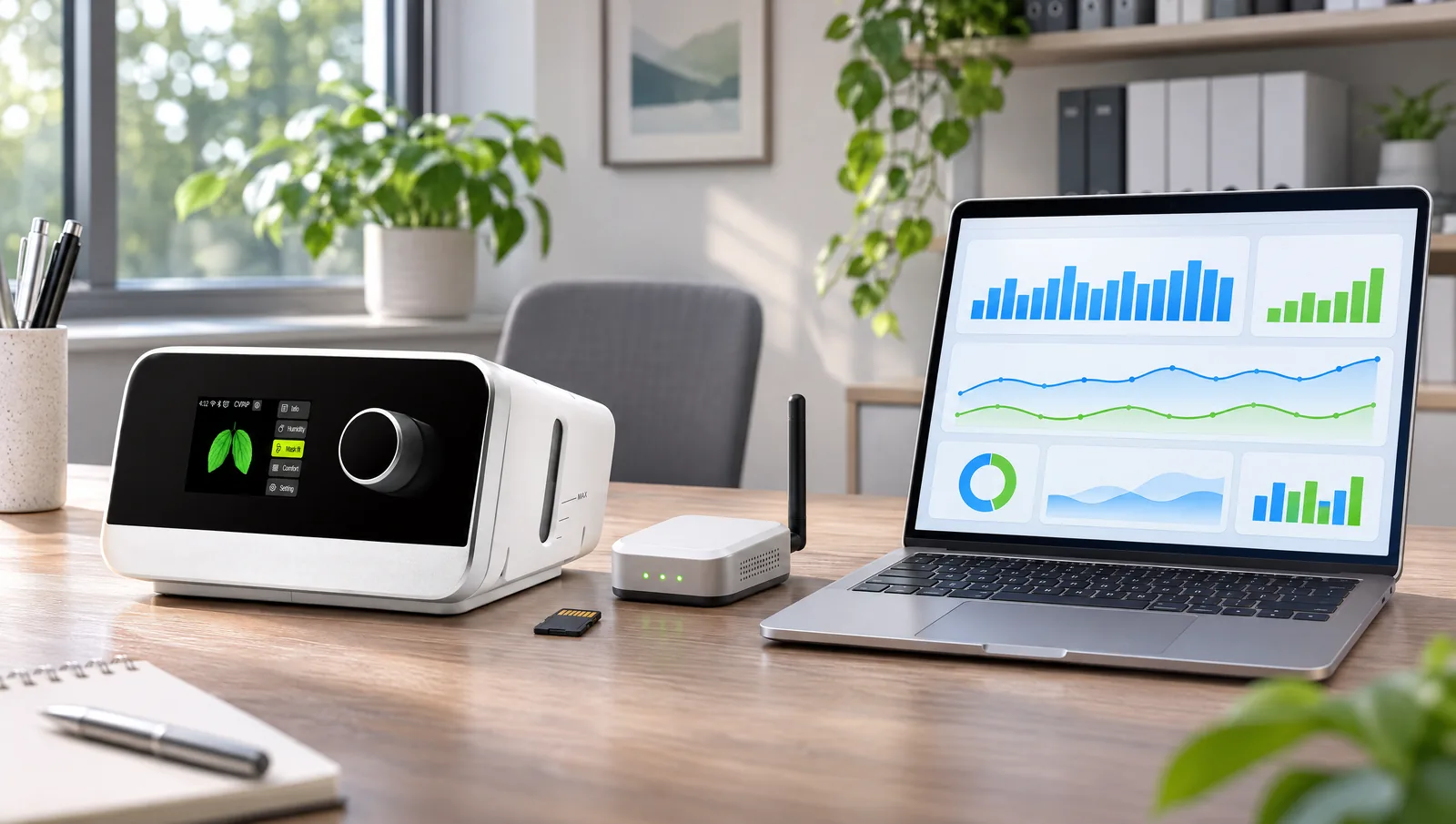

Key Takeaways
- A CPAP compliance report summarizes usage hours, nights used, device-detected AHI, leak and pressure over a period.
- Data reaches you in one of three ways: SD card, Wi-Fi to the cloud, or a cellular module to the cloud.
- The iBreeze line stores data on SD card as standard, with optional Wi-Fi or GSM/GPRS upload to the ResAssist™ cloud.
- Medicare's benchmark is 4 hours a night on 70% of nights in a 30-day window; Latin American payers set their own rules, so confirm them per contract.
- Treat therapy data as personal health data: agree access roles, hosting and a data processing agreement before rollout.
Short answer: a CPAP compliance report is a summary of how a patient used the device over a period: hours of use per night, the share of nights used, the device-detected apnea-hypopnea index (AHI), mask leak and pressure. The device records the data; you retrieve it from an SD card or receive it automatically in a cloud platform by Wi-Fi or a cellular module. Payers use these reports to confirm that therapy is being used.
This guide is for homecare providers, distributors and program managers who need adherence data from a CPAP fleet in Latin America. It does not cover clinical interpretation, which belongs to the treating clinician.
What does a CPAP compliance report contain?
| Metric | What it shows | Who uses it |
|---|---|---|
| Usage hours per night | How long the device ran with the mask on | Payers, program managers |
| Nights used (%) | Share of nights above a usage threshold | Payers, program managers |
| Device-detected AHI | Residual events per hour as estimated by the device | Treating clinician |
| Leak | Mask leak trend | Technicians, respiratory therapists |
| Pressure | Delivered pressure trend, including auto mode percentiles | Treating clinician |
Device-detected AHI is an estimate, not a diagnostic test. Reports are inputs for the clinician and the payer, not a substitute for clinical review.
What is the compliance benchmark?
In the United States, Medicare's coverage policy for PAP devices uses a well-known benchmark: use of 4 hours or more per night on at least 70% of nights during a consecutive 30-day period within the first three months of therapy. Many private payers and programs outside the US use the same benchmark as a reference, but Latin American public and private payers set their own rules. Confirm the exact requirement in each contract before you choose a data setup.
SD card, Wi-Fi or cellular: three ways to get the data
| Path | How it works | Strengths | Limits |
|---|---|---|---|
| SD card | Data is stored on a card in the device; staff read it with software | No connectivity cost; works everywhere | Requires a visit or the patient mailing the card; data arrives late |
| Wi-Fi to cloud | The device uploads data through the patient's home network | Automatic, near-daily data; no data plan | Depends on patient Wi-Fi and setup at home |
| Cellular (GSM/GPRS) to cloud | A cellular module uploads data over the mobile network | Works without home internet; no patient setup | SIM or data plan cost; needs mobile coverage |
Most programs use the SD card as the standard record and add connectivity where the payer requires continuous reporting or where home visits are expensive.
How the iBreeze data stack works
- SD card as standard on the iBreeze CPAP/APAP, iBreeze III and iBreeze BPAP.
- Optional Wi-Fi or GSM/GPRS modules send therapy data to the ResAssist™ cloud platform.
- ResAssist™ uploads AHI, usage hours, leak and pressure trends, supports fleet dashboards, and allows authorized users to change prescription settings remotely.
- The manufacturer's iMatrix software is used to review device data. Confirm the current version and licensing in your quote.
Can third-party software read iBreeze data?
Plan on the manufacturer's software. As of this writing, the published supported-machines list for OSCAR, a popular open-source viewer, does not include Resvent devices. If a program depends on a specific third-party tool, verify compatibility with a pilot unit before purchase.
Can a CPAP send adherence data without Wi-Fi?
Yes, with a cellular module. Rural patients and many urban homes in the region have no reliable Wi-Fi, so a GSM/GPRS module is often the practical choice. Budget the SIM or data plan per device per month and check mobile coverage in the areas you serve before deciding which share of the fleet gets cellular.
Remote prescription changes: set the rules first
Remote settings changes save visits, but only authorized clinicians should be able to make them. Before rollout, define user roles in the cloud platform, who approves a pressure change, and how each change is documented in the patient record.
Data governance in Mexico and Colombia
Therapy data is personal health data. In Mexico, personal data held by private parties is governed by the federal personal data protection law; in Colombia, by Law 1581 of 2012. Ask where the cloud platform is hosted, who can access patient data, and sign a data processing agreement with the supplier. Your legal team should confirm the requirements for your program.
A compliance workflow for a CPAP fleet
- Confirm the payer's reporting requirement and period.
- Decide which patients get Wi-Fi, which get cellular and which stay on SD card.
- Register each device by serial number in the cloud platform and link it to the patient record.
- Review usage weekly in the first month and call patients below the threshold.
- Export the report for the payer at the end of the period and archive it.
SysMed USA supplies connected respiratory devices to institutional buyers and supports onboarding in key Latin American markets. Request a quote and tell us how many units need Wi-Fi or cellular modules.
References
- CMS LCD L33718: Positive Airway Pressure (PAP) Devices for the Treatment of Obstructive Sleep Apnea
- Apnea Board wiki: OSCAR supported machines
- Resvent iBreeze CPAP/APAP, iBreeze III and iBreeze BPAP manufacturer datasheets: product pages
- Colombia, Law 1581 of 2012 on personal data protection
Frequently Asked Questions
What therapy data does a CPAP device record?
Typical PAP devices record usage hours, the apnea-hypopnea index (AHI) detected by the device, mask leak and pressure trends. On the iBreeze line this data is stored on an SD card and, with an optional Wi-Fi or GSM/GPRS module, uploaded to the ResAssist™ cloud for remote monitoring.
What is the difference between SD card and cloud data on a CPAP?
The SD card stores therapy data inside the device; someone has to collect the card or the device to read it. Cloud monitoring sends the data automatically over Wi-Fi or a cellular module, so a program can check adherence and leaks without a home visit.
Most programs use the SD card as the standard record and add connectivity where payers require ongoing compliance reports.
Can a CPAP send compliance data without Wi-Fi?
Yes, with a cellular module. The iBreeze line offers an optional GSM/GPRS module that transmits therapy data to the ResAssist™ cloud where patients have no Wi-Fi, which is common in rural areas.
Budget for the SIM or data plan and check mobile coverage in the areas you serve.


