How Long Does a CPAP Machine Last? Lifespan and Replacement Planning for Fleets (2027)
CPAP lifespan for institutional fleets: the five-year planning benchmark, what shortens device life, supply replacement schedules and how to budget replacement.


Key Takeaways
- Plan on about five years per device: Medicare uses a five-year reasonable useful lifetime (RUL) for PAP devices, a widely used planning benchmark.
- The RUL is a payment rule, not an engineering limit. Real life depends on hours of use, maintenance, power quality and climate.
- Supplies wear out much faster: as a reference, Medicare allows tubing every 3 months and headgear and water chambers every 6 months.
- Budget device replacement, annual consumables per active patient and a rotation reserve for units in repair.
- Track hours and faults by serial number, and confirm warranty terms in the quote.
Short answer: plan on about five years for a CPAP machine. In the United States, Medicare uses a five-year reasonable useful lifetime (RUL) for PAP devices before it pays for a routine replacement, and that figure is widely used as a planning benchmark. Actual life depends on hours of use, maintenance, power quality and climate. Masks, cushions, tubing and filters wear out much faster and need their own schedule.
This guide is for homecare providers, distributors and program managers who budget and replace CPAP fleets in Latin America.
Is the five-year lifetime a technical limit?
No. The RUL is a reimbursement rule. Under Medicare policy, a PAP device replaced before five years is covered only for loss, theft or irreparable damage from a specific incident. After five years, replacement requires an in-person evaluation by the treating practitioner documenting that the patient still uses and benefits from the device. Many devices keep working beyond five years; others fail earlier under heavy use or poor conditions. Use five years as your budget cycle and your own fleet data to adjust it.
What shortens a CPAP machine's life?
- High hours of use wear the blower motor faster.
- Dust and smoke clog filters and make the blower work harder. Replace filters on schedule.
- Hard water in the humidifier leaves mineral deposits. Follow the manufacturer's water guidance.
- Unstable power and voltage spikes stress electronics. Surge protection helps where the grid is unreliable.
- Heat and humidity outside the operating range shorten component life.
- Transport and handling between patients cause drops and connector damage.
- Harsh cleaning chemicals not approved by the manufacturer can damage plastics and seals.
How often should CPAP supplies be replaced?
Medicare's allowed replacement frequencies are a useful reference. They are payment limits, not clinical rules, and a US government audit has noted that manufacturers and clinicians sometimes recommend different frequencies. Latin American payers set their own rules, so follow the manufacturer's instructions and your contract.
| Supply | Medicare allowed frequency |
|---|---|
| Full face mask | 1 every 3 months |
| Full face mask cushion | 1 per month |
| Nasal mask | 1 every 3 months |
| Nasal mask cushion or nasal pillows | 2 per month |
| Tubing (standard or heated) | 1 every 3 months |
| Disposable filter | 2 per month |
| Non-disposable filter | 1 every 6 months |
| Headgear | 1 every 6 months |
| Chinstrap | 1 every 6 months |
| Humidifier water chamber | 1 every 6 months |
Masks such as the iRiFiT N300 and F300 fit any device with a standard 22 mm connection, which lets you stock one mask range across device models.
How to budget fleet replacement
A simple model has three lines:
- Device replacement. Divide the active fleet by the replacement cycle. A 500-unit fleet on a five-year cycle needs about 100 replacement units a year, plus growth.
- Consumables. Multiply active patients by the annual quantity of each supply your payer or protocol allows.
- Rotation reserve. Keep a share of extra units for devices in repair, in transit or being reprocessed. Size it from your own repair times.
Add data plans if part of the fleet uses cellular modules. See CPAP compliance reports and data access.
Replace with evidence, not only by calendar
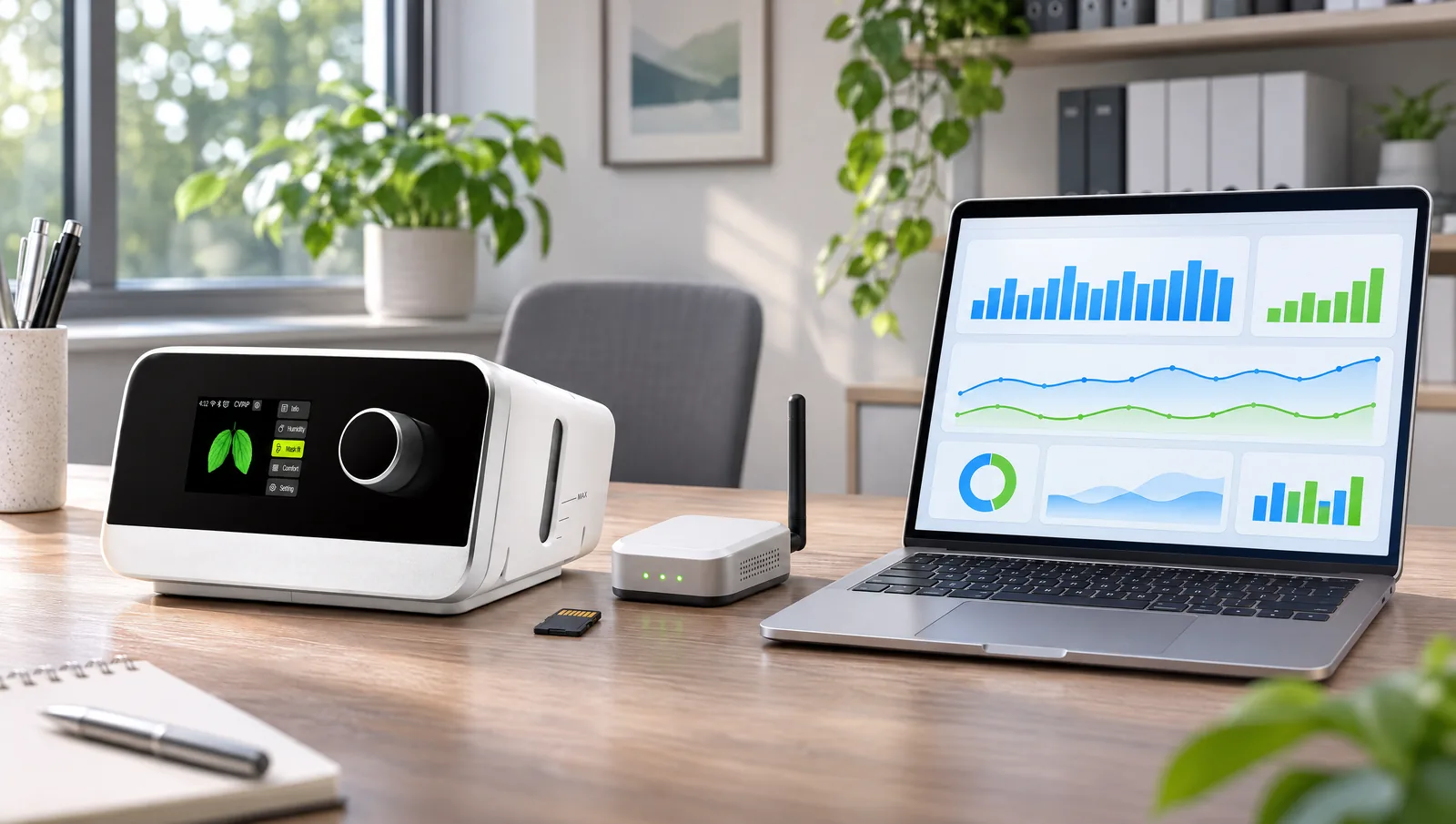
Log every device by serial number: hours of use, faults, repairs and patient assignments. The iBreeze CPAP/APAP and iBreeze BPAP record therapy data on SD card, and optional Wi-Fi or GSM/GPRS modules send it to the ResAssist™ cloud, which helps you see usage across the fleet. Devices with repeated faults can be retired early; devices in good condition at five years can be inspected before deciding.
Reprocessing between patients
Patient-contact parts such as masks and tubing are not reused between patients. Clean and inspect the device, replace filters and follow the manufacturer's reprocessing instructions before reassigning it. Record the serial number and the date of each reassignment for traceability and post-market surveillance.
What about warranty?
Warranty terms vary by model, market and contract. Confirm the term, what it covers and how repairs or replacements are handled in your quote, and align it with your replacement budget.
SysMed USA supplies devices, masks and spare parts to institutional buyers and supports technical onboarding in key Latin American markets. Request a quote with your fleet size and replacement cycle.
References
- CMS LCD L33718: Positive Airway Pressure (PAP) Devices for the Treatment of Obstructive Sleep Apnea
- CMS Policy Article A52467: PAP devices for the treatment of obstructive sleep apnea
- Noridian: Positive airway pressure devices, replacement (dear clinician letter)
- Resvent iBreeze manufacturer instructions for use: product pages
Frequently Asked Questions
How long does a CPAP machine last?
Plan on about five years. US Medicare uses a five-year reasonable useful lifetime for PAP devices before it pays for a replacement, and that figure is widely used as a planning benchmark.
Actual life depends on hours of use, maintenance, power quality and climate, so track hours and faults per unit.
How often should CPAP masks, tubing and filters be replaced?
Under the US Medicare schedule, disposable filters can be replaced twice a month, tubing every three months, and non-disposable filters, headgear and humidifier water chambers every six months.
Payers in Latin America set their own rules, so follow the manufacturer's instructions and your contract terms.
How should a program budget for CPAP fleet replacement?
Budget device replacement on a roughly five-year cycle, consumables every year per active patient, and a rotation reserve for units in repair or reprocessing. Track hours and faults per serial number so you replace units on evidence, not by calendar alone.