How to Compare Auto CPAP Machines (2027): Spec Checklist for Buyers
A buyer's checklist for comparing auto CPAP machines across modes, pressure range, noise, humidification, data access, masks, registration and service.
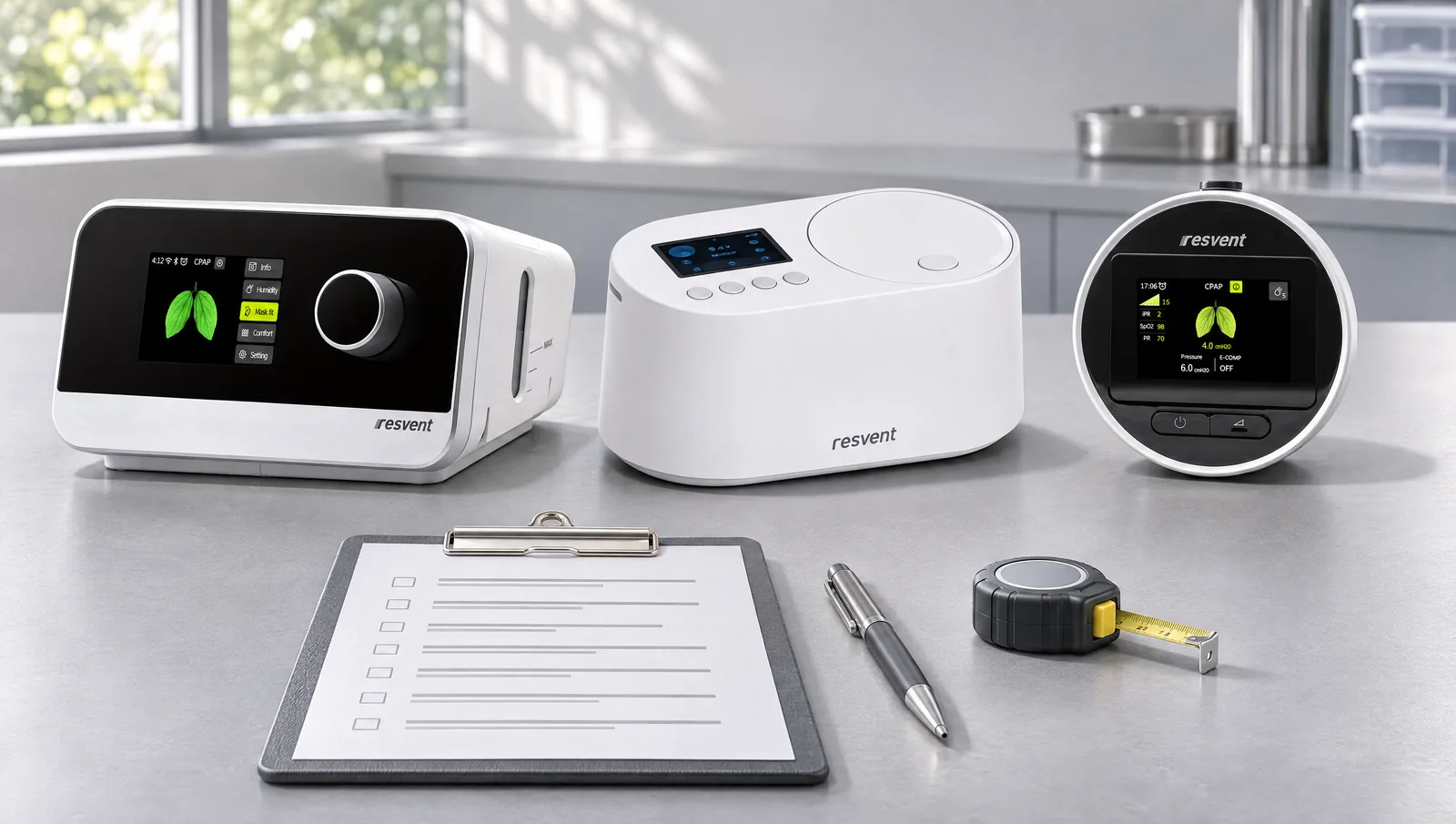

Key Takeaways
- There is no single best auto CPAP for every program. The best fit is the model that meets your prescriptions, data, service and registration requirements at a sustainable cost.
- Compare like for like: request the same datasheet fields from every bidder, including how noise was measured.
- A dual-mode CPAP/APAP lets one SKU cover fixed and auto prescriptions, which simplifies stock and training.
- Data access (SD card, Wi-Fi, cellular, cloud) often matters more to payers than any single comfort feature.
- Confirm sanitary registration in each destination country and warranty terms in the quote before you score price.
Short answer: to compare auto CPAP machines, score each model on the same criteria: therapy modes and pressure range, declared noise and how it was measured, humidification, data access (SD card, Wi-Fi, cellular and cloud), comfort features, mask compatibility, size and power, sanitary registration in each destination country, and the supplier's spare parts and service. Ask every bidder for the same fields so the comparison is fair.
Buyers often search for the "best auto CPAP". For an institutional fleet, the best machine is the one that fits your prescriptions, payer reporting and service model at a cost you can sustain for five years. This checklist is written for procurement teams, homecare providers and distributors buying in volume in Latin America.
What is an auto CPAP?
An auto CPAP (APAP) adjusts delivered pressure within a prescribed minimum and maximum, responding to events the device detects during the night. A fixed CPAP delivers one constant pressure. Many current devices do both, so the treating clinician chooses the mode and the pressure limits for each patient. For an overview of device types, see our guide to CPAP vs BiPAP vs APAP.
Auto CPAP spec checklist
| Criterion | What to ask the supplier | Why it matters for a fleet |
|---|---|---|
| Therapy modes | CPAP only, APAP only, or both? Any "Pro" or advanced modes? | A dual-mode unit covers more prescriptions with one SKU. |
| Pressure range | Minimum and maximum in cmH₂O | Must cover the prescriptions you serve. |
| Auto algorithm | What events it responds to and what documentation supports it | Clinical teams will ask before approving a new model. |
| Declared noise | Value in dB(A), measurement standard and distance | Numbers measured differently cannot be compared. |
| Humidification | Integrated or separate, number of levels, heated tubing option | Affects comfort, adherence and consumable spend. |
| Data access | SD card, Wi-Fi, cellular module, cloud platform, report types | Drives compliance reporting and remote follow-up. |
| Comfort features | Ramp, expiratory pressure relief, leak compensation, altitude adjustment | Reduces early drop-out and support calls. |
| Mask compatibility | Standard 22 mm connection? | Lets you standardize masks across devices. |
| Size, weight, power | Dimensions, weight, input voltage range, battery option | Logistics, home placement and unstable power grids. |
| Registration | Sanitary registration number per model and country | No registration, no legal sale or tender. |
| Service and parts | Spare parts lead time, local technical support, training | Downtime costs more than the unit price difference. |
| Warranty | Term, coverage and repair or replacement process | Confirm in writing in the quote. |
How the iBreeze range maps to the checklist
The table below uses manufacturer data for the Resvent iBreeze devices SysMed USA supplies. Fields not yet confirmed are marked TBC; request the current datasheet with your quote.
| Spec | iBreeze CPAP/APAP | iBreeze III | iBreeze+ |
|---|---|---|---|
| Modes | CPAP, APAP | CPAP, CPAP Pro, APAP, APAP Pro | CPAP, APAP |
| Pressure range | 4 to 20 cmH₂O | 4 to 20 cmH₂O | 4 to 20 cmH₂O |
| Declared noise | ≤28 dB(A) | ≤25 dB | TBC |
| Screen | 3.5" color LCD | Touch LCD | Touch screen |
| Humidification | Heated humidifier, 8 levels, ambient humidity detection | Heated humidifier, heated tubing option | Detachable water tank |
| Data | SD card; optional Wi-Fi or GSM/GPRS | SD card; optional Wi-Fi or GSM | TBC |
| Comfort | Smart Ramp up to 60 min, IPR, leak compensation, altitude adjustment | Auto Start/Stop, Ramp, IPR, Mask Fit detection | TBC |
| Weight and power | About 1.5 kg; AC 100 to 240 V | TBC | 680 g; battery up to 12 h, optional modular battery |
| Role in a fleet | Standard bedside unit | Bedside unit where low noise and touch control matter | Travel, backup and unreliable power |
See the product pages for the iBreeze CPAP/APAP, iBreeze III and iBreeze+.
How should buyers compare noise ratings?
Only compare declared noise values measured to the same standard and at the same distance. A lower number on a different test is not a quieter machine. Our guide on how to read CPAP dB(A) ratings explains what to ask.
Why data access belongs on the scorecard
Many payers and programs require proof that patients use their therapy. A device that stores data on an SD card and can send it to a cloud platform by Wi-Fi or a cellular module lets you report adherence without home visits. See CPAP compliance reports and data access for the options.
When is an auto CPAP not enough?
Some prescriptions need two pressure levels or a backup rate. Those patients need a bilevel device such as the iBreeze BPAP (S, ST, T and CPAP modes). Plan a smaller bilevel pool alongside your auto CPAP fleet. The prescription is always the clinician's decision.
Do not forget the mask
Mask fit affects leak, noise and adherence as much as the device does. Standardizing on 22 mm masks such as the iRiFiT N300 nasal mask and F300 full face mask, each supplied with S, M and L cushions, simplifies stock across device models.
How to run a fair evaluation
- Send every bidder the same specification sheet to complete.
- Ask for registration numbers, certificates and the instructions for use in Spanish (or Portuguese for Brazil).
- Request a few pilot units and test them with your technicians and a small patient group.
- Score each criterion with weights agreed in advance by procurement, clinical and technical teams.
- Compare total cost over five years: device, consumables, data plans, service and downtime.
SysMed USA supplies institutional buyers only. Request a quote with your volumes and destination countries and we will send current datasheets for the models you are evaluating.
References
- Resvent iBreeze CPAP/APAP, iBreeze III and iBreeze+ manufacturer datasheets: product pages
- ISO 80601-2-70: particular requirements for sleep apnoea breathing therapy equipment
- CMS LCD L33718: Positive Airway Pressure (PAP) Devices for the Treatment of Obstructive Sleep Apnea
Frequently Asked Questions
What should buyers compare between auto CPAP machines?
Compare therapy modes and pressure range, the declared noise level and how it was measured, humidification, data access (SD card, Wi-Fi, cellular and cloud), mask compatibility, size and power options, sanitary registration in each destination country, and the supplier's spare parts and service.
Use each manufacturer's spec sheet for figures, and ask for the same data from every bidder so the comparison is like for like.
Can one auto CPAP cover both fixed CPAP and APAP prescriptions?
Yes, if it is a dual-mode device. The iBreeze CPAP/APAP runs in fixed CPAP or auto mode across 4 to 20 cmH₂O, so one model covers both prescription types.
The mode and pressure settings are always set by the treating clinician.
When does a CPAP fleet need a travel or battery unit?
A compact unit makes sense for patients who travel, for homecare programs in areas with unreliable power, and as a backup device. The iBreeze+ weighs 680 g and runs up to 12 hours on battery, with an optional modular battery.
Most fleets keep travel units as a small pool alongside bedside devices.


