How Does an Oxygen Concentrator Work?
How an oxygen concentrator works: compressor, zeolite sieve beds and PSA, oxygen purity, continuous vs pulse flow, alarms, power use, maintenance and lifespan.

Key Takeaways
- An oxygen concentrator pulls in room air, traps nitrogen in zeolite sieve beds (pressure swing adsorption) and delivers concentrated oxygen through a nasal cannula.
- WHO requires an oxygen concentration above 82%; most units deliver 82% to 96%, and purity can dip at maximum flow.
- Stationary units deliver continuous flow; many portables use pulse dose, and a pulse setting may not equal the same continuous flow setting.
- Medical concentrators need alarms for low purity, no flow, power failure and high temperature, plus an hour meter.
- With technician service yearly or every 5,000 hours, a concentrator can run five years or more; WHO cites up to seven.
An oxygen concentrator works by pulling in room air, pressurizing it with a compressor and passing it through beds of zeolite, a mineral that traps nitrogen. The beds take turns in a process called pressure swing adsorption (PSA), and the device delivers concentrated oxygen, up to 95.5% according to the World Health Organization (WHO), through a nasal cannula at the flow your physician prescribes. It runs on electricity and never needs refilling.
Below we explain each step inside the machine, how pure the oxygen is, continuous flow vs pulse dose, the alarms a medical concentrator should have, power use and noise, maintenance and how long a concentrator lasts.
What is an oxygen concentrator?
An oxygen concentrator is an electrically powered medical device that concentrates oxygen from the air around you. It is used for prescribed oxygen therapy in people with low blood oxygen, for example from COPD, pulmonary fibrosis or late-stage heart failure. It is the most common source for long-term home oxygen because it makes oxygen from room air, with no cylinders or deliveries. Your physician always sets the flow, the hours of use and the follow up. For the full treatment picture, read our guide to oxygen therapy at home, and if you are weighing a concentrator against a cylinder, see oxygen concentrator vs oxygen tank.
How does an oxygen concentrator work, step by step?
The air we breathe is about 21% oxygen and 78% nitrogen. A concentrator separates the two in a continuous cycle, as WHO describes it in its technical specifications:
- Air intake and filtering: room air passes through a gross particle filter and an intake filter that catch dust.
- Compression: a compressor raises the air pressure.
- Cooling: a heat exchanger lowers the temperature of the compressed air.
- Separation in the zeolite sieve beds: the air enters a molecular sieve bed filled with zeolite, which adsorbs nitrogen at high pressure and lets oxygen pass.
- Switching and purging: as one bed depressurizes, it releases the trapped nitrogen back into the room while the other bed keeps separating gas. Valves switch the beds automatically.
- Storage and delivery: the concentrated oxygen collects in a product tank and leaves through a flowmeter that sets the liters per minute (LPM) to the nasal cannula or mask, passing through a humidifier bottle if one is used.
What is pressure swing adsorption (PSA)?
Adsorption means nitrogen molecules stick to the surface of the zeolite when pressure rises and are released when it falls. By swinging the pressure between beds, the machine produces oxygen continuously using nothing but air and electricity. WHO warns that drawing more flow than the manufacturer intends reduces sieve bed performance and lets oxygen concentration drop too low.
Oxygen concentrator parts and what they do
| Component | Function |
|---|---|
| Intake and gross particle filters | Catch dust before the compressor; cleaned by the user |
| Compressor | Pressurizes the air; the moving part with the most wear |
| Heat exchanger | Cools the compressed air before the sieve beds |
| Molecular sieve beds (zeolite) | Trap nitrogen and let oxygen through |
| Valves | Control the pressure cycles between the beds |
| Product tank | Stores the concentrated oxygen |
| Flowmeter | Sets the flow in liters per minute |
| Oxygen monitor and alarms | Warn when concentration drops or a fault occurs |
| Hour meter | Records hours of use to schedule maintenance |
| Humidifier bottle and nasal cannula | Humidify the oxygen when indicated and deliver it to the patient |
How pure is the oxygen from a concentrator?
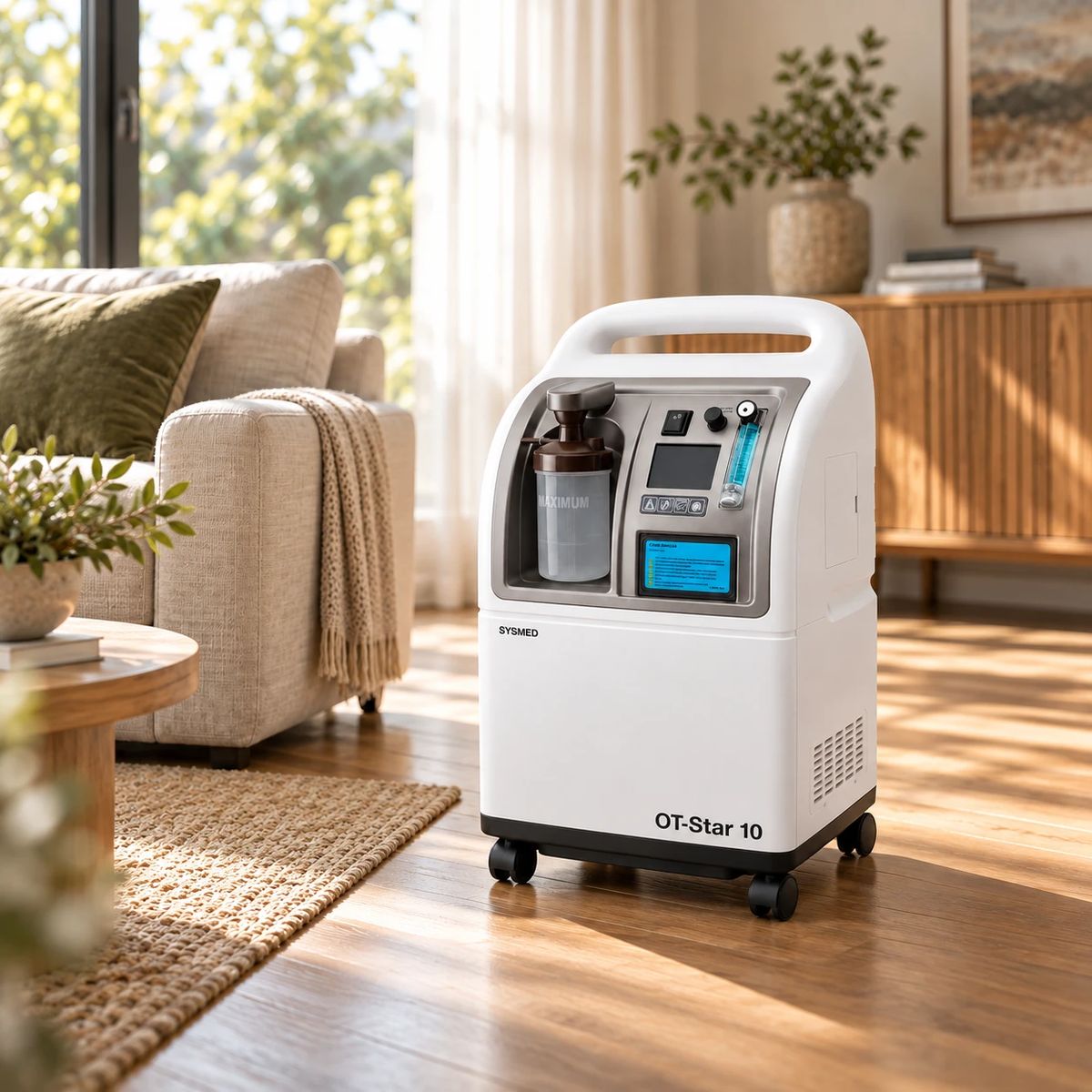
Oxygen purity, or oxygen concentration, is the percentage of oxygen in the gas the device delivers. WHO specifies that a concentrator must deliver continuous flow at an oxygen concentration above 82%, and notes that most produce between 82% and 96% when operated within the manufacturer's specifications. Cleveland Clinic describes the output as 90% to 95% pure oxygen. For reference, the O2 Tiger M50 delivers 93% ±3% at 5 LPM, and the OT-Star 10 delivers 93% ±3% up to 8 LPM and 90% ±3% at 10 LPM.
As the OT-Star 10 figures show, purity can dip at maximum flow. Heat and humidity also lower it, which is why WHO requires the minimum concentration to hold at maximum flow, at 40 °C (104 °F), 95% relative humidity and an air pressure equal to 2,000 meters (about 6,560 feet) of altitude.
One caution: the American Lung Association warns that some over-the-counter concentrators may not meet the needs of people with COPD or pulmonary fibrosis who require prescription oxygen. Before buying, check the stated purity, the FDA status and the device's registration in your country.
Continuous flow vs pulse dose
A continuous flow concentrator delivers a steady stream of oxygen in liters per minute whether you inhale or exhale. Stationary concentrators work this way, including both models SysMed USA distributes. A pulse dose device releases a burst of oxygen only when it senses an inhalation. WHO explains that this saves oxygen and battery power, which is why it is common in portable concentrators, which usually have a capacity of 3 LPM or less.
A pulse setting is not necessarily the same as the matching continuous flow number: the American Lung Association notes that they may differ and advises checking with your provider that the device meets your prescription. Your physician decides which type of flow you need, including during sleep.
5 liter vs 10 liter oxygen concentrators
The liter rating is the maximum flow the device can deliver. A 5 liter unit covers prescriptions up to 5 LPM; a 10 liter unit handles higher flows but weighs more and uses more power. The starting point is always the flow on the prescription. We compare both sizes, with market price ranges by country, on our 5 and 10 liter oxygen concentrators page.
Oxygen concentrator alarms and purity indicators
A medical grade concentrator must tell you when something is wrong. WHO specifies an oxygen monitor that indicates when concentration falls below 82%, plus alarms for:
- Low oxygen concentration (below 82%).
- No flow.
- High or low pressure.
- Low battery, on units that have one.
- Power supply failure.
- High temperature.
WHO also calls for an hour meter that records cumulative operating hours for maintenance. The purity alarm matters because, as WHO notes, a faulty concentrator can still put out gas richer than room air but below 82%. The OT-Star 10, for example, has an LCD screen with status indicators and a therapy timer. If any alarm sounds, follow the manufacturer's manual and call your supplier.
Power use and noise
According to WHO, stationary concentrators draw roughly 280 to 600 W depending on the model, and portable units about 40 to 130 W. WHO also sets a power efficiency of 70 W per LPM or less and a noise limit of 50 dB(A). The O2 Tiger M50 draws 300 W and runs at 45 dB or less; the OT-Star 10 draws up to 600 W and runs at 50 dB or less.
To estimate electricity use, multiply wattage by hours: 300 W for 24 hours is 7.2 kWh a day, about 216 kWh a month. At startup a concentrator draws two to three times its rated wattage, which matters when sizing a UPS or battery backup.
Oxygen concentrator maintenance: filters and preventive service
Maintenance happens at two levels:
- Patient or caregiver: clean the gross particle filter as the manual directs; WHO advises doing it weekly, or more often in dusty rooms, with mild detergent, a rinse and full drying. Wipe the exterior with the unit unplugged, use distilled water in the humidifier bottle and change the water daily, and replace the cannula and tubing on your supplier's schedule.
- Trained technician: WHO recommends scheduled, documented maintenance at least once a year, ideally every three to four months, or every 5,000 hours of use. It includes checking oxygen concentration with a calibrated oxygen analyzer, checking pressures and, when needed, repairing the compressor or replacing internal parts.
Hot, humid or dusty environments call for more frequent service. Homecare providers should log every service by serial number and hours of use.
How long does an oxygen concentrator last?
WHO states that concentrators are designed for continuous operation and can produce oxygen 24 hours a day, 7 days a week, for up to five years or more. An analysis of a hospital concentrator fleet in Gambia, cited by WHO, found a useful life of up to seven years or more with proper maintenance and repair. The compressor wears the most and can be repaired or replaced when the manufacturer supplies parts. Actual lifespan depends on hours of use, maintenance, power quality and environment.
Oxygen concentrators for clinics, homecare providers and distributors
SysMed USA supplies the O2 Tiger M50 (5 L) and the OT-Star 10 (10 L) at wholesale: two continuous flow stationary concentrators that are CE marked, made in an ISO 13485 and GMP certified facility. Both support an optional GSM module for fleet tracking, as explained in How Connected CPAP and Oxygen Concentrators Transform Respiratory Care. Request a wholesale quote for your hospital, homecare network or distribution business in Latin America.
References
Frequently Asked Questions
How does an oxygen concentrator work?
An oxygen concentrator draws in room air, which is about 21% oxygen and 78% nitrogen, filters it and compresses it through two beds of zeolite sieve material that trap nitrogen. The beds alternate under pressure in a process called pressure swing adsorption (PSA).
The result is a continuous flow of oxygen at roughly 93% purity, delivered through a nasal cannula at the rate the physician prescribes. The unit runs on electricity and never needs refilling. Stationary models such as the OT-Star 10 and the O2 Tiger M50 include a humidifier bottle for comfort.
What is the difference between continuous flow and pulse dose oxygen?
A continuous flow concentrator delivers a steady stream of oxygen in liters per minute whether you inhale or exhale. Stationary units such as the OT-Star 10 and the O2 Tiger M50 work this way. A pulse dose device releases a burst of oxygen only when it senses an inhalation, which saves oxygen and battery power, so it is common in portable concentrators.
A pulse setting is not necessarily equal to the same continuous flow number: the American Lung Association notes that they may differ and advises checking with your provider that the device meets your prescription. Your physician decides which type of flow you need, including during sleep.
How long does an oxygen concentrator last?
WHO technical specifications state that oxygen concentrators are designed for continuous operation and can produce oxygen 24 hours a day, 7 days a week, for up to five years or more. An analysis of a hospital concentrator fleet in Gambia, cited by WHO, found a useful life of up to seven years or more with proper maintenance and repair.
Lifespan depends on hours of use, maintenance, power quality and environment: heat, humidity, dust and voltage swings shorten it. The compressor wears the most and can be repaired or replaced. Clean the intake filter as the manual directs and schedule technician service at least once a year or every 5,000 hours of use.
What maintenance does an oxygen concentrator need?
Routine care is simple. Wash the air intake filter as the user manual directs, use only distilled water in the humidifier bottle and clean the bottle regularly, and replace the nasal cannula and tubing on the schedule set by the manufacturer or your provider. Keep the unit away from walls and curtains so it can ventilate, and away from heat sources or open flames.
Internal filters and sieve beds are serviced by a trained technician following the manufacturer's service schedule, and homecare providers should log each service by serial number. Each SysMed USA unit ships with a humidifier bottle, a nasal cannula and a user manual in English and Spanish.
How much electricity does an oxygen concentrator use?
It depends on the model and the flow setting. A 5 liter unit such as the O2 Tiger M50 draws 300 W, which is about 7.2 kWh per day, or 216 kWh per month, if it runs 24 hours a day. A 10 liter unit such as the OT-Star 10 draws up to 600 W, or up to 14.4 kWh per day at full load.
Multiply those figures by your local electricity rate to estimate the monthly cost. Because a concentrator stops when the power goes out, patients in areas with frequent outages usually keep a backup cylinder as their physician advises, and institutions should plan for voltage protection.