Oxygen Therapy at Home: A Complete Guide for Patients and Caregivers
A guide to oxygen therapy at home: who needs it, prescriptions, concentrators vs tanks vs liquid oxygen, fire safety, power outages, travel and home programs.

Key Takeaways
- Oxygen therapy at home delivers more oxygen than room air (21%) to correct hypoxemia, usually through a nasal cannula, and always requires a prescription.
- Your physician sets the flow, hours per day and follow up; for COPD with severe resting hypoxemia, the ATS recommends at least 15 hours a day.
- The four sources are stationary concentrators, portable concentrators, cylinders and liquid oxygen; many patients pair a concentrator with a backup cylinder.
- Oxygen makes things burn much faster: never smoke and keep equipment at least 6 feet (2 meters) from flames and heat.
- Home oxygen programs need training, maintenance by hours of use, power protection and periodic reassessment of every patient.
Oxygen therapy at home is a prescribed treatment that gives you air with more oxygen than room air (about 21%) to correct or prevent low blood oxygen, called hypoxemia. At home it is usually delivered through a nasal cannula connected to an oxygen concentrator, a compressed gas cylinder or a liquid oxygen system. It always requires a prescription: your physician sets the flow in liters per minute, the hours of use per day and the follow up plan.
This guide explains who may need home oxygen therapy, the main oxygen sources and how they compare, how to use the equipment safely, how to travel with oxygen and how hospitals and homecare providers run home oxygen programs. It does not replace your physician's advice.
What is oxygen therapy?
Oxygen is treated as a medication. When the lungs or heart cannot keep blood oxygen at a healthy level, supplemental oxygen helps more of it reach the organs and tissues. MedlinePlus describes oxygen therapy as a treatment that provides extra oxygen to breathe in, also called supplemental oxygen, and notes that it can be used in the hospital or at home.
Supplemental oxygen raises blood oxygen while you are using it. That is why guidelines specify a minimum number of hours per day, instead of using oxygen only when you feel short of breath.
Low flow vs high flow oxygen
Home oxygen is almost always low flow oxygen: a two prong nasal cannula mixes the oxygen with the air you breathe. High flow systems and hyperbaric oxygen therapy (pure oxygen inside a pressurized chamber) are different treatments that are given in hospitals or specialized centers.
Who needs oxygen therapy at home?
The decision depends on a measurement of your blood oxygen (an arterial blood gas or pulse oximetry) taken by your physician, not on the diagnosis alone. These are the most common situations described by guidelines and medical sources:
- COPD (chronic obstructive pulmonary disease): the American Thoracic Society (ATS) guideline recommends long-term oxygen therapy for severe chronic resting hypoxemia, defined as a PaO2 of 55 mm Hg or less or an SpO2 of 88% or less, or a PaO2 of 56 to 59 mm Hg or SpO2 of 89% with signs such as edema, a hematocrit of 55% or more, or P pulmonale on an ECG.
- Pulmonary fibrosis and other interstitial lung diseases: the ATS recommends long-term oxygen for severe resting hypoxemia and suggests ambulatory oxygen when oxygen levels drop sharply with exertion.
- Heart failure: MedlinePlus lists late-stage heart failure among the conditions that may require oxygen.
- COVID-19 and pneumonia: MedlinePlus also lists both. In these cases the need may be temporary, so your physician rechecks your oxygen levels to decide when to stop.
- Other conditions: a severe asthma attack, cystic fibrosis and some cases of sleep apnea, according to MedlinePlus. For obstructive sleep apnea the main treatment is positive airway pressure (CPAP), and oxygen is added only if your physician prescribes it.
The ATS guideline adds an important nuance: for adults with COPD and moderate resting hypoxemia (SpO2 of 89% to 93%), it suggests not prescribing long-term oxygen therapy. More oxygen is not always better, which is why you should never start oxygen on your own.
Your prescription: flow, hours per day and follow up
A home oxygen prescription sets three things that only your physician should change:
- Flow in liters per minute (LPM): it may differ at rest, during exertion and during sleep. The American Lung Association is clear: never change the flow rate unless your provider tells you to.
- Hours of use per day: for COPD or interstitial lung disease with severe resting hypoxemia, the ATS recommends long-term oxygen for at least 15 hours a day. Some patients need it 24 hours a day.
- Follow up: your physician rechecks your oxygen levels over time. If oxygen was started during an acute illness, it may no longer be needed once you recover.
Altitude matters too. The World Health Organization (WHO) explains that above 2,000 meters (about 6,560 feet) the oxygen pressure in the air is lower, so patients may need higher flow rates or longer use than at sea level. That is relevant in high altitude cities such as Mexico City, Bogotá or Quito, and it is one more reason the prescription must come from a physician who knows where the patient lives.
Home oxygen options compared
There are four main sources of home oxygen. Many patients combine two: a primary source at home and a backup or portable source for outings.
Stationary oxygen concentrator
An electric device that pulls in room air, removes most of the nitrogen and delivers concentrated oxygen continuously. It never runs out as long as it has power, which makes it the most common primary source for long-term therapy. According to WHO, stationary models deliver flows of up to 10 LPM depending on the model. To see how it works inside, read our guide How Does an Oxygen Concentrator Work?
Portable oxygen concentrator
A battery powered unit for use away from home. WHO notes that portable concentrators usually have a capacity of 3 LPM or less and that many deliver oxygen in pulses only when you inhale, which saves battery. The American Lung Association warns that a pulse dose setting may differ from your continuous flow setting, so your provider should confirm the device meets your prescription.
Compressed oxygen cylinders (tanks)
Cylinders hold oxygen gas under high pressure. They need no electricity, but the supply is limited and must be refilled or replaced. MedlinePlus describes large tanks to keep at home and small tanks to take with you, and stresses keeping them secured: a tank that falls and cracks can fly like a missile. Cylinders are the usual backup for a concentrator during power outages.
Liquid oxygen
Oxygen cooled into liquid form and stored in a home reservoir, from which smaller portable units are filled. MedlinePlus explains that liquid oxygen takes up less space and is easy to move, but it slowly evaporates even when you are not using it. The ATS suggests portable liquid oxygen for mobile patients who need high continuous flows. Availability depends on the medical gas suppliers in each area.
| Source | Needs electricity? | Supply | Advantages | Limitations |
|---|---|---|---|---|
| Stationary concentrator | Yes, wall outlet | Continuous while powered | No refills or deliveries; continuous flow up to 10 LPM depending on model | Stops in a power outage; most weigh under 27 kg (60 lb); uses electricity |
| Portable concentrator | Rechargeable battery | Hours per charge | Lets you leave home and travel; some models are accepted on aircraft | Low capacity (3 LPM or less); many deliver pulses only |
| Compressed gas cylinder | No | Limited to tank contents | Works without power; useful as backup and for short outings | Needs refills and transport; weight; hazard if it falls |
| Liquid oxygen | No | Limited; evaporates even when unused | A lot of oxygen in little space; light portable units | Needs regular deliveries; availability varies |
For a deeper look at the two most common options, read oxygen concentrator vs oxygen tank for home use. If you are sourcing equipment, our 5 and 10 liter oxygen concentrators page includes a buying guide and comparison table.
Home oxygen safety: fire, smoke, humidification and power outages
Fire and smoke
As MedlinePlus puts it, oxygen makes things burn much faster. Its safety advice includes:
- Never smoke, and do not let anyone smoke, in a room where oxygen is used. Post “No Smoking” signs.
- Keep oxygen at least 6 feet (about 2 meters) away from stoves, candles, fireplaces, space heaters, electric blankets and hair dryers.
- Make sure smoke detectors and a fire extinguisher are working.
- In the kitchen, keep oxygen away from burners and the oven.
- Do not use petroleum jelly or oil-based creams on your face; use water-based products or aloe vera instead.
- Do not store oxygen in a closed closet or trunk, and secure the tubing so no one trips over it.
Humidification and nasal comfort
Oxygen can dry out the nose and cause nosebleeds, according to MedlinePlus. Many concentrators include a humidifier bottle, but humidification is not always needed: WHO advises following clinical guidelines and considers it more relevant at higher flows. If your provider recommends it, fill the bottle only with distilled water, wash it with warm soapy water every time you refill it, as the American Lung Association advises, and change the water daily.
Power outages and backup
A concentrator stops when the power goes out. MedlinePlus advises concentrator users to keep a backup oxygen tank and to tell the electric company that someone in the home uses oxygen. WHO adds practical guidance for areas with unstable power:
- Use a voltage stabilizer and a surge protector, because voltage swings damage the unit over time.
- An uninterruptible power supply (UPS) covers a few minutes to half an hour at most, and must be sized for the concentrator's starting wattage, which is two to three times its rated wattage.
- Longer outages call for battery banks or generators installed by a technician.
Ask your physician or supplier for a written plan: what to do in an outage, how long your backup cylinder lasts at your prescribed flow and whom to call.
Daily use and equipment care
A few simple habits keep therapy safe and the equipment in good shape:
- Placement: leave open space around the concentrator so it can ventilate, away from curtains, walls and heat sources.
- Every week: wash the nasal cannula, clean the air filter and wipe the outside of the concentrator with soap and warm water, as the American Lung Association recommends. In dusty rooms, WHO advises cleaning the filter more often.
- Every 2 months: replace the tubing, per the American Lung Association, or on the schedule your supplier sets.
- Technician service: WHO recommends service by a trained technician at least once a year or every 5,000 hours of use, including a check of oxygen concentration with an analyzer.
- Warning signs: MedlinePlus and the American Lung Association advise calling your physician if you have frequent headaches, confusion, drowsiness, bluish lips or fingernails, or trouble breathing.
Can you sleep with oxygen on?
Yes, when your physician prescribes oxygen during sleep. Long-term oxygen guidelines count nighttime hours toward the daily total, and WHO notes that concentrators are designed to run continuously, 24 hours a day. For restful nights, keep the unit the recommended distance from any heat source, route the tubing so you will not get tangled and place the concentrator where its noise will not disturb you: the O2 Tiger M50, for example, runs at 45 dB or less.
Traveling with oxygen
Home oxygen does not have to keep you from traveling, but it takes planning:
- Flying: MedlinePlus advises telling your airline at least two weeks before you travel, because many airlines have special rules. The Federal Aviation Administration (FAA) accepts on board only portable oxygen concentrators that meet its acceptance criteria and carry a specific manufacturer label.
- Batteries: plan for the full trip and bring enough charged batteries; the American Lung Association notes that battery life depends on your setting and how fast you breathe.
- At your destination: confirm with a local supplier that oxygen will be available when you arrive, as MedlinePlus suggests.
- Altitude: if you are traveling to a high altitude city, talk to your physician first, since WHO notes that higher altitude may require a higher flow.
- Paperwork: carry a copy of your prescription and your oxygen supplier's phone number.
How hospitals and homecare providers run home oxygen programs
Behind most patients on home oxygen is an institution: a hospital discharging the patient, an insurer or a homecare company that delivers and maintains the equipment. A well run program follows these steps:
- Prescription and records: the physician sets flow, hours and source type, and the program records the order and the reassessment date.
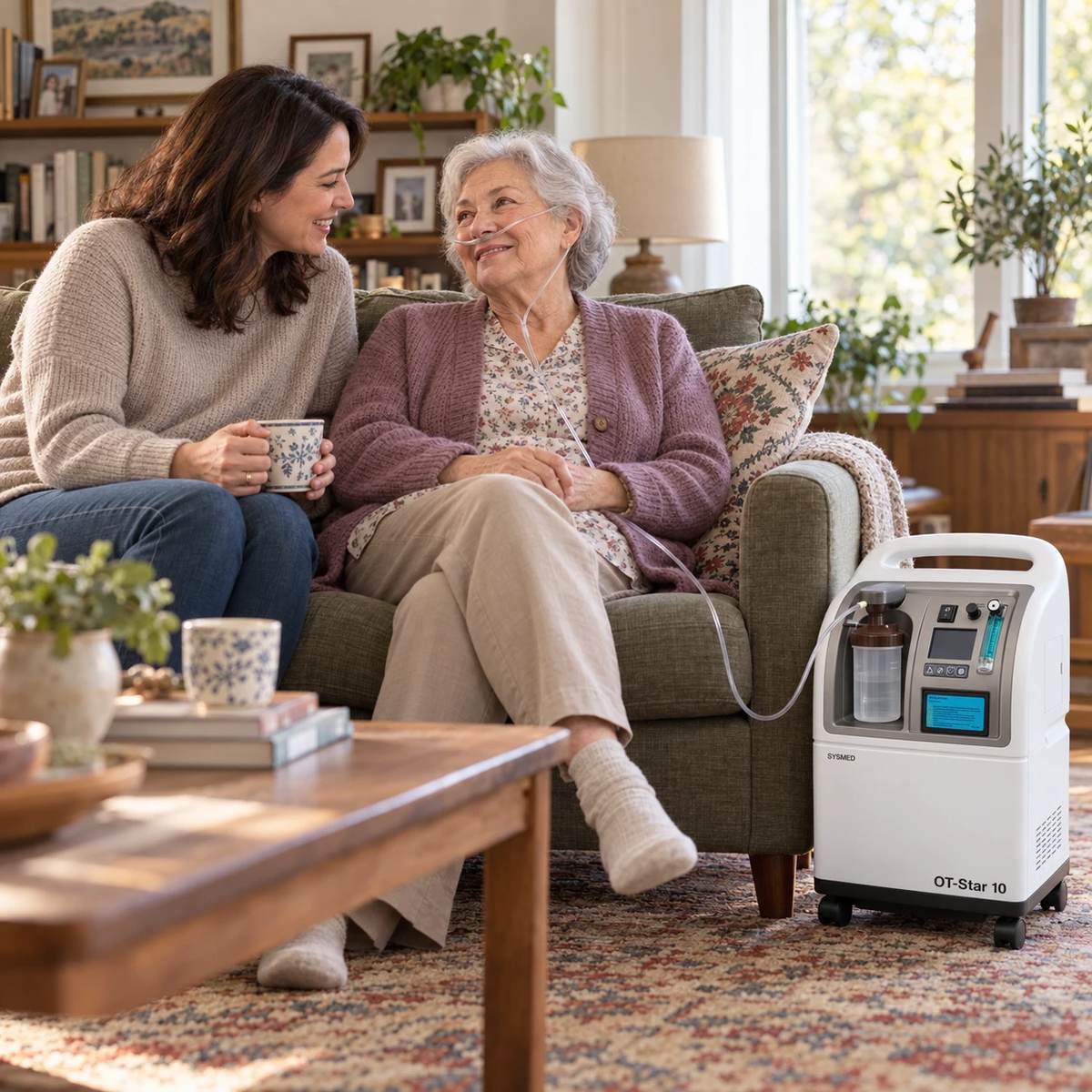
- Equipment assignment: a stationary concentrator as the primary source and, when prescribed, a backup cylinder or portable unit. The O2 Tiger M50 (1 to 5 LPM, 300 W, 14.2 kg) and the OT-Star 10 (1 to 10 LPM, up to 600 W, 26 kg) cover low and high flow prescriptions with continuous flow.
- Installation and training: the ATS treats it as best practice that every patient receives instruction on the equipment and education on oxygen safety, including smoking cessation and fire prevention.
- Preventive maintenance by hours of use: WHO specifies that concentrators include an hour meter; logging each service by serial number and hours lets providers schedule service before units fail.
- Power protection and backup: voltage stabilizers in areas with unstable power and a backup plan for each patient.
- Follow up and equipment recovery: periodic reassessment lets programs stop oxygen for patients who no longer need it and reassign the unit. Both SysMed USA models support an optional GSM module to locate the fleet and monitor use, as explained in How Connected CPAP and Oxygen Concentrators Transform Respiratory Care.
Both concentrators are CE marked, are made in an ISO 13485 and GMP certified facility, and ship with a humidifier bottle, a nasal cannula and a user manual in English and Spanish. SysMed USA supports registration with documentation for regulators such as COFEPRIS in Mexico, INVIMA in Colombia, ISP in Chile and ANMAT in Argentina.
Do you run a clinic, a homecare company or a medical equipment distributorship? SysMed USA supplies home oxygen programs across Latin America on volume-based wholesale terms. Request a wholesale quote and we will help you size your concentrator fleet.
References
- MedlinePlus: Oxygen Therapy
- MedlinePlus: Using oxygen at home
- MedlinePlus: Oxygen safety
- Jacobs SS, et al. Home Oxygen Therapy for Adults with Chronic Lung Disease. An Official American Thoracic Society Clinical Practice Guideline, 2020
- American Lung Association: Oxygen Therapy, Using Oxygen at Home
- American Lung Association: Getting Started with a Portable Oxygen Concentrator
- World Health Organization: WHO technical specifications for oxygen concentrators, 2015
- Federal Aviation Administration: Portable Oxygen Concentrators
Frequently Asked Questions
How many hours a day should home oxygen be used?
Your physician sets the number of hours, and it varies by condition. For adults with COPD or interstitial lung disease who have severe low blood oxygen at rest, the American Thoracic Society recommends long-term oxygen therapy for at least 15 hours a day, and some patients need it 24 hours a day. Others are prescribed oxygen only during exertion or sleep.
Supplemental oxygen raises blood oxygen while it is being used, so following the prescribed hours matters. Do not increase or reduce the hours or the flow on your own, and ask your physician to recheck your oxygen levels at each follow up visit.
Can you sleep with oxygen on at home?
Yes, when your physician prescribes oxygen during sleep. Long-term oxygen guidelines count nighttime hours toward the daily total, and WHO notes that oxygen concentrators are designed to run continuously, 24 hours a day.
For safe overnight use, keep the concentrator at least 6 feet (about 2 meters) from heaters, candles and other heat sources, never smoke in the bedroom, leave open space around the unit so it can ventilate and route the tubing so you will not trip or get tangled. Noise also matters in a bedroom: the O2 Tiger M50, for example, runs at 45 dB or less. Never change your nighttime flow without your physician's approval.
What are the side effects of oxygen therapy at home?
Oxygen therapy is generally safe when used as prescribed. MedlinePlus lists a dry or bloody nose, tiredness and morning headaches as possible side effects. A water-based lubricant or aloe vera can ease nasal dryness; avoid petroleum jelly and oil-based creams.
The biggest risk is fire, because oxygen makes materials burn much faster, so no one should smoke near the equipment. Call your physician if you have frequent headaches, confusion, unusual drowsiness, bluish lips or fingernails or trouble breathing, because your prescription may need to be reviewed. Never adjust the flow on your own.
Can I use an oxygen concentrator during a power outage?
No. Home oxygen concentrators require a continuous electrical connection to operate: they extract oxygen from room air using an electric compressor. If the power goes out, the device stops.
That is why many patients keep a backup oxygen cylinder at home to cover power outages. If you live in an area with frequent outages, talk to your doctor about the most suitable backup system for your treatment.
Do you need a prescription for an oxygen concentrator?
Yes. Oxygen is treated as a medication, and home oxygen therapy should start only with a physician's prescription that sets the flow in liters per minute, the hours of use per day and the follow up plan. The physician also decides when to adjust or stop the therapy.
The import and sale of the device are regulated by each country's health authority, such as COFEPRIS in Mexico, INVIMA in Colombia, ISP in Chile, ANMAT in Argentina or DIGEMID in Peru. The OT-Star 10 and the O2 Tiger M50 are CE marked and manufactured under ISO 13485, and SysMed USA provides documentation to support registration.