What Is a CPAP Machine and How Does It Work?
What a CPAP machine is, what it does and how it works: its parts, who uses it, CPAP vs APAP vs BiPAP, getting used to therapy and how to clean it.

Key Takeaways
- A CPAP machine delivers room air at a steady pressure through a hose and mask to keep the airway open during sleep.
- It mainly treats obstructive sleep apnea; it requires a prescription and the physician sets the pressure.
- Its parts are the device, mask, hose, humidifier and filters; the mask has a big effect on comfort.
- APAP adjusts pressure automatically, while BiPAP uses two pressures for specific cases.
- It only works when used; a common benchmark is 4 hours a night on 70 % of nights.
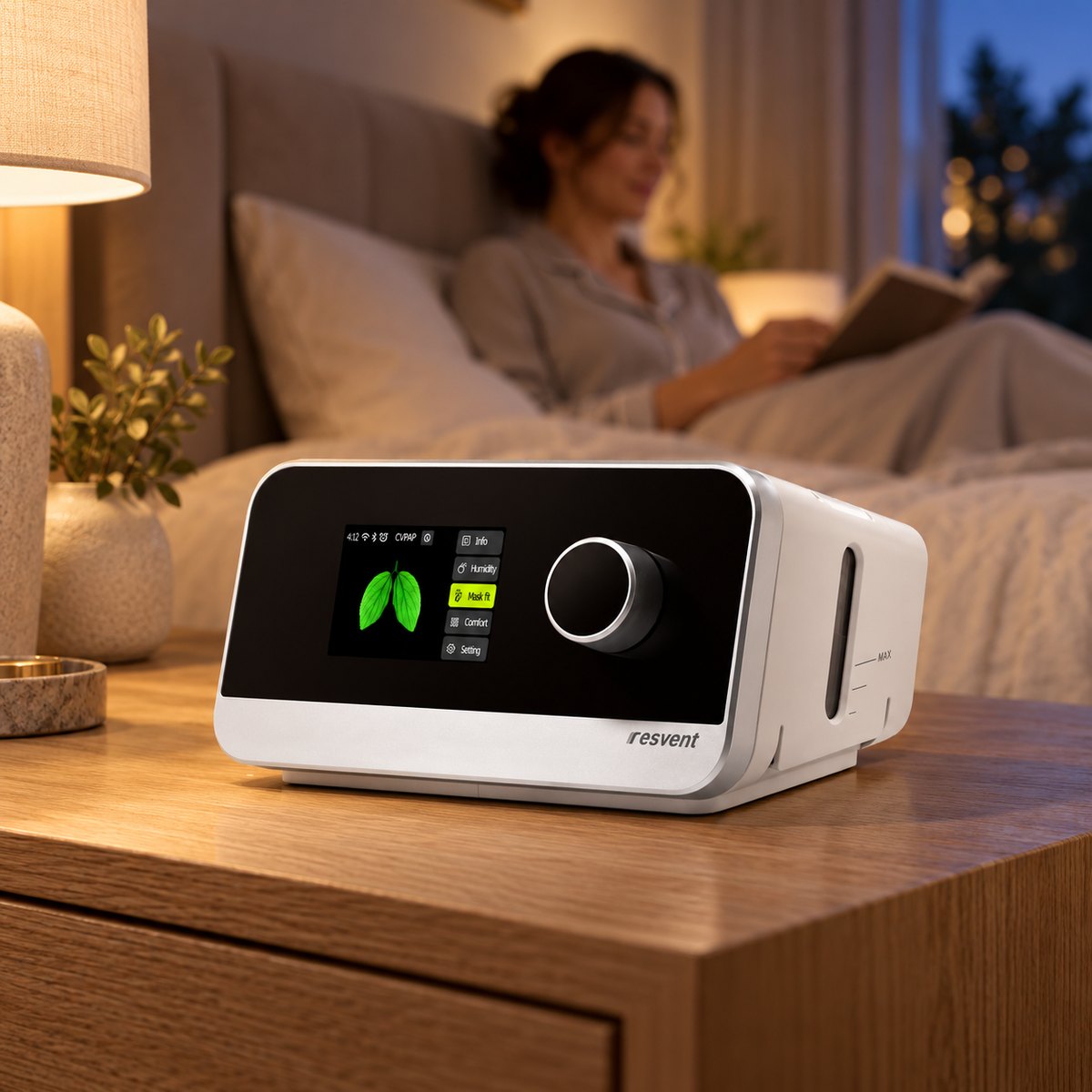
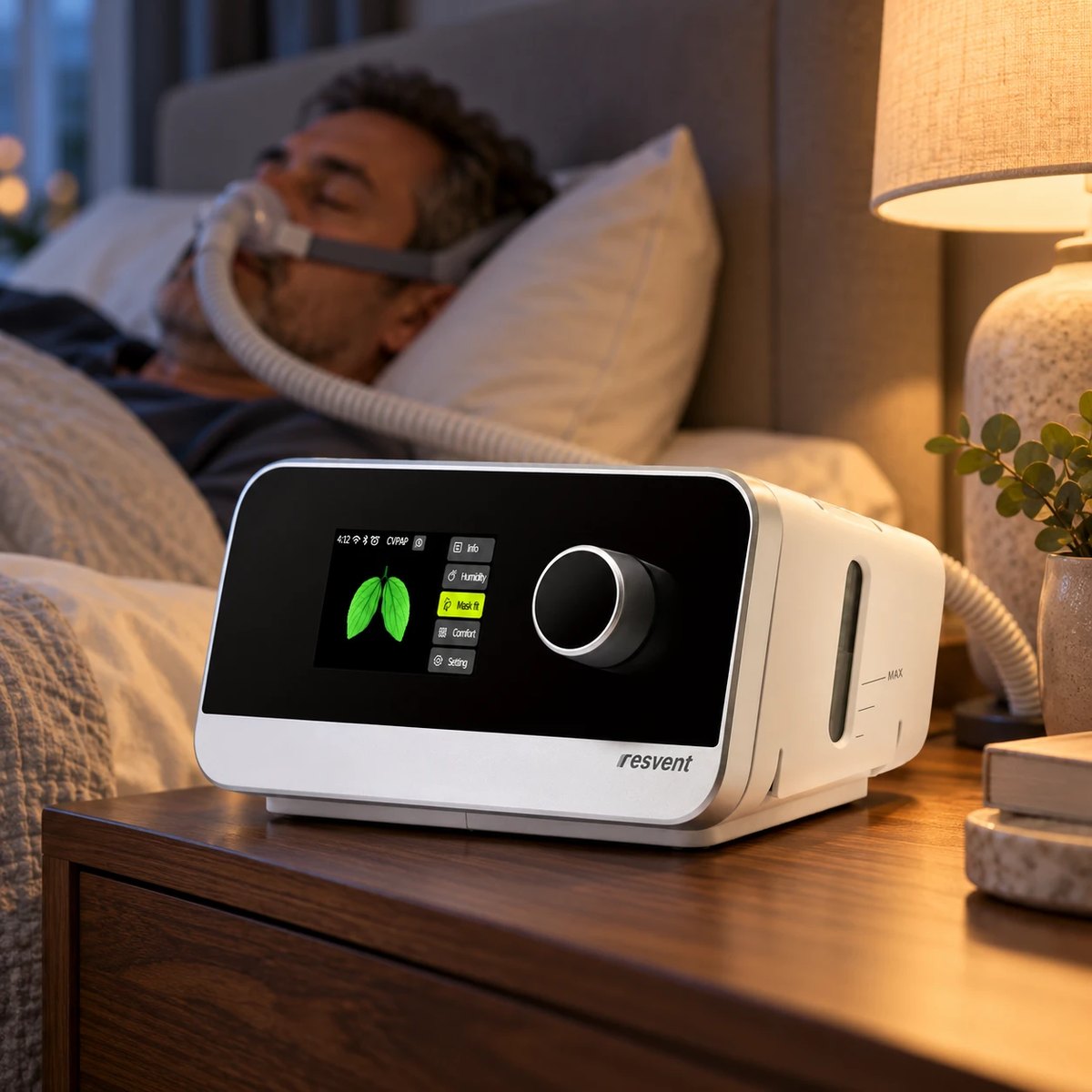
A CPAP machine (continuous positive airway pressure) is a prescription medical device that draws in room air, filters it and delivers it at a steady pressure through a hose and mask. That pressure holds the throat open during sleep and prevents the breathing pauses of obstructive sleep apnea. It works like an air splint: a small turbine pressurizes the air, an optional humidifier warms and moistens it, and the mask delivers it through the nose or nose and mouth. CPAP delivers pressurized room air, not oxygen, and the physician sets the pressure.
What does a CPAP machine do?
In obstructive sleep apnea, the throat muscles relax during sleep and the airway closes again and again. CPAP pressure stops that collapse. With regular use, a CPAP machine helps:
- Prevent breathing pauses and overnight drops in oxygen.
- Reduce or eliminate snoring.
- Improve daytime sleepiness and sleep quality.
- Control a condition linked to high blood pressure and cardiovascular disease.
The American Academy of Sleep Medicine (AASM) recommends positive airway pressure for adults with obstructive sleep apnea and excessive sleepiness. Hospitals also use CPAP systems for newborns and for acute respiratory failure, but those are different devices and settings than home CPAP. To understand the condition itself, read our guide to sleep apnea treatment options, symptoms and diagnosis.
How does a CPAP machine work?
- It draws in and filters room air.
- A turbine pressurizes it to the prescribed level, measured in centimeters of water (cmH₂O).
- A humidifier, if used, warms and moistens the air to prevent dryness.
- The hose carries the air to the mask.
- The mask delivers it through the nose or nose and mouth, while a vent lets exhaled air escape.
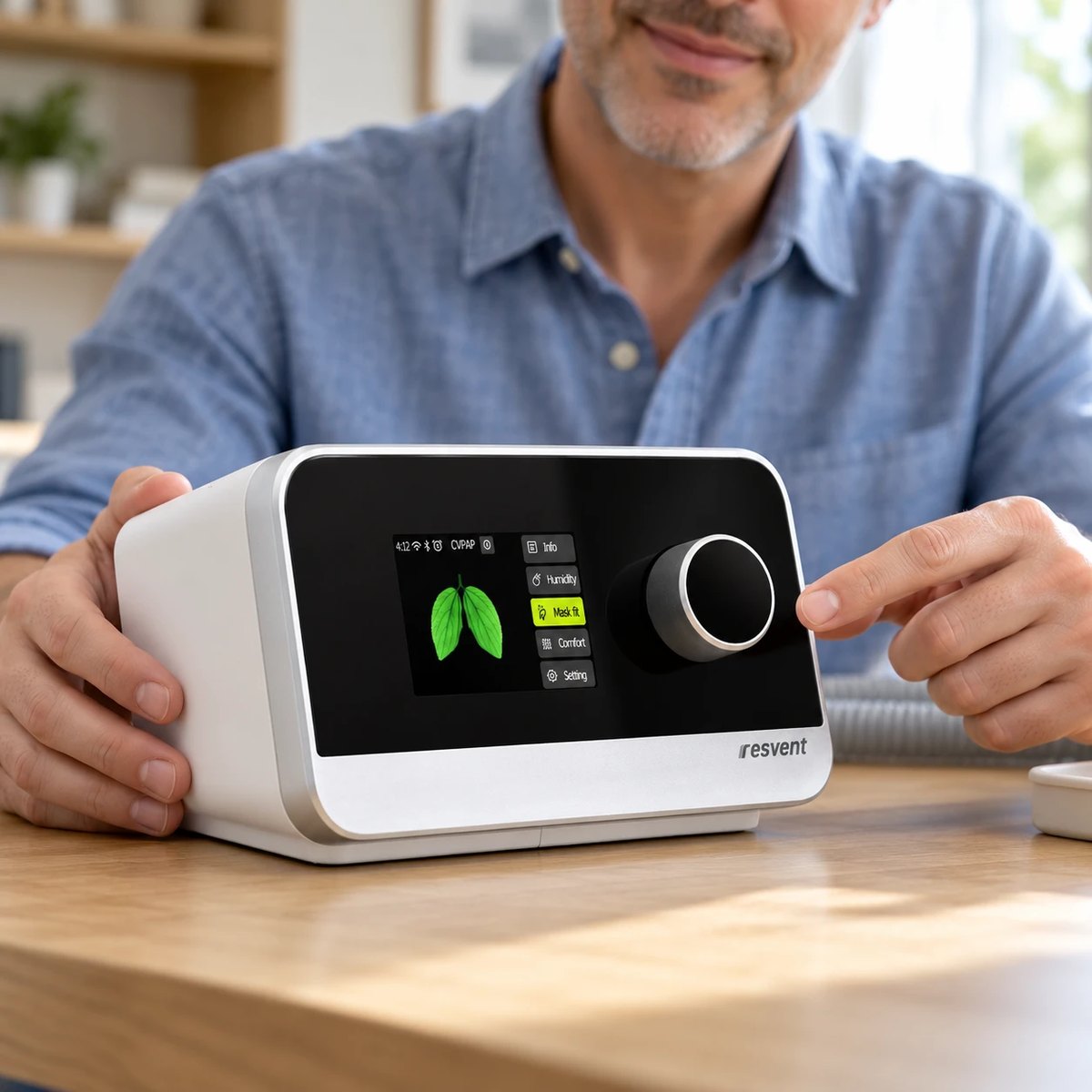
Home devices typically work within a range of 4 to 20 cmH₂O, and the physician sets each patient's pressure, usually after a sleep study or titration. Modern machines add comfort features: a ramp (pressure starts low and rises as you fall asleep), exhalation pressure relief, automatic leak compensation and recording of usage hours, leak and residual apnea-hypopnea index (AHI).
Parts of a CPAP machine
| Part | What it does | What to check |
|---|---|---|
| Device (flow generator) | Turbine, sensors, display and memory; some include a WiFi or cellular modem | Pressure range, noise, data card, voltage |
| Mask | The patient interface: nasal, nasal pillows or full face | Size, seal, comfort for side sleeping |
| Hose | Carries the air; the standard size is 22 mm, with slim and heated versions | Cracks, condensation, secure connection |
| Humidifier | Heater plate and water chamber that moisten the air | Distilled water, cleaning, humidity level |
| Filters | Trap dust and particles in the incoming air | Replace on the manufacturer's schedule |
The mask is chosen separately and makes a big difference to comfort. Nasal masks such as the iRiFiT N300 seal around the nose; full face masks such as the iRiFiT F300 cover the nose and mouth for mouth breathers. Compare options in CPAP masks and interfaces or read about the best CPAP mask for side sleepers.
Who uses a CPAP machine?
CPAP is used by adults with moderate to severe obstructive sleep apnea, and by some with mild apnea and symptoms, based on the physician's judgment. The usual path is a medical visit, a sleep study (in-lab polysomnography or a home sleep test), a diagnosis and a prescription. For central apnea, hypoventilation or COPD overlap, a specialist may prescribe other modes such as bilevel. CPAP is not a treatment for simple snoring without diagnosed sleep apnea.
CPAP vs APAP vs BiPAP in brief
- CPAP: one fixed pressure all night.
- APAP (auto CPAP): adjusts pressure breath by breath within a range the physician sets. The iBreeze CPAP/APAP runs both modes from 4 to 20 cmH₂O, as does the iBreeze III series.
- BiPAP (bilevel): a higher pressure to inhale and a lower one to exhale, for patients who need more support.
For the full comparison, including indications and buying criteria, see CPAP vs BiPAP vs APAP. To compare models and specifications, browse our CPAP, APAP and BiPAP machine guide.
Getting used to CPAP
The first few weeks are the hardest. These steps help:
- Practice while awake: wear the mask for a few minutes while reading or watching TV.
- Fit the mask lying down with the machine running; overtightening often makes leaks worse.
- Use the ramp and humidifier if your physician recommends them.
- Use it every night, for the whole night and during naps.
- Review your data on usage and leaks and share it with your care team.
How many hours a night? Ideally, the whole time you sleep. As a benchmark, US Medicare considers a patient adherent at 4 or more hours a night on 70 % of nights during 30 consecutive days in the first three months.
Common side effects include nasal or mouth dryness, congestion, mask marks or skin irritation, air leaks, a closed-in feeling and swallowing air. Most improve with a different mask size or type, humidification or setting changes that only the physician should make. Never change the pressure on your own.
How to clean a CPAP machine
- Daily: empty the humidifier chamber, let it air dry and refill it only with distilled water before use. Wipe the mask cushion.
- Weekly: wash the mask, headgear, hose and water chamber in warm water with mild soap, rinse well and air dry away from direct sunlight.
- Filters: check and replace them on the schedule in the manufacturer's manual.
- Device: unplug it and wipe the outside with a dry or slightly damp cloth.
According to the FDA, no device is FDA cleared or approved for cleaning, disinfecting or sanitizing CPAP machines. It has authorized only one add-on device that reduces bacteria on specific masks and hoses after regular cleaning, and it does not replace that cleaning. Manufacturers recommend mild soap and water. Always follow the instructions for your model.
Is CPAP for life?
CPAP controls sleep apnea while you use it, but it does not remove the cause, so for most people treatment is long term. If something important changes, such as significant weight loss or surgery, the physician may repeat the sleep study and reassess therapy. To budget the full cost, including masks, filters and tubing, see how much a CPAP machine costs in Latin America.
CPAP machines for clinics, homecare providers and distributors
SysMed USA supplies Latin American providers wholesale with the iBreeze CPAP/APAP, the iBreeze III series, the 680 g iBreeze+ travel CPAP and iRiFiT masks, with an SD card and optional WiFi or GSM modules to track each patient's use. Learn more about remote monitoring in connected CPAP and oxygen concentrators. Hospitals, clinics, homecare providers and distributors can request a wholesale quote.
References
- National Heart, Lung, and Blood Institute (NHLBI, NIH): CPAP
- MedlinePlus: Positive airway pressure treatment
- Patil SP et al. Treatment of Adult Obstructive Sleep Apnea with Positive Airway Pressure (AASM), 2019
- CMS: Local Coverage Determination L33718, Positive Airway Pressure (PAP) Devices for the Treatment of Obstructive Sleep Apnea
- FDA: Do You Need a Device That Claims to Clean a CPAP Machine? (2024)
Frequently Asked Questions
How many hours a night should you use a CPAP?
Ideally, CPAP is used every time you sleep, for the whole night, including naps, because breathing pauses return as soon as the mask comes off. A widely used adherence benchmark, the US Medicare definition, is at least 4 hours a night on 70 % of nights during 30 consecutive days in the first three months of therapy.
That benchmark is a minimum, not a goal. If discomfort, leaks or dryness make it hard to keep the mask on, talk to your care team: a different mask, humidification or a setting change made by the physician often helps. Machines that record usage, such as the iBreeze CPAP/APAP, make follow-up easier.
How do you clean a CPAP machine?
Follow your model's manual. A typical routine: every day, empty the humidifier chamber, let it air dry and refill it only with distilled water, and wipe the mask cushion. Every week, wash the mask, headgear, hose and water chamber in warm water with mild soap, rinse well and air dry away from direct sunlight. Check and replace filters on the manufacturer's schedule, and wipe the outside of the unplugged device with a dry or slightly damp cloth.
According to the FDA, no device is FDA cleared or approved for cleaning CPAP machines; it has authorized only one add-on device that reduces bacteria on specific masks and hoses. Manufacturers recommend mild soap and water.
What are the side effects of CPAP?
Most CPAP side effects are mild and related to comfort: dry nose or mouth, nasal congestion, mask marks or skin irritation, air leaks that make noise or dry the eyes, a closed-in feeling, and swallowing air, which can cause bloating.
They usually improve with a better-fitting mask or a different type (nasal, nasal pillows or full face), heated humidification, a ramp at the start of the night and time to adapt. Pressure changes must be made by the physician. Report persistent problems to your care team instead of stopping therapy. Compare options in CPAP masks and interfaces.
What is the difference between CPAP, APAP and BiPAP?
CPAP delivers one constant pressure all night, set by the physician. APAP (auto CPAP) adjusts pressure breath by breath between a prescribed minimum and maximum. BiPAP (also called BPAP or bilevel) delivers a higher inspiratory pressure (IPAP) and a lower expiratory pressure (EPAP), and its ST and T modes can add timed breaths.
CPAP and APAP are used for obstructive sleep apnea. BiPAP is prescribed when a patient needs two pressure levels or more support, for example in central apnea, COPD overlap or obesity hypoventilation. The iBreeze CPAP/APAP covers 4 to 20 cmH₂O and the iBreeze BPAP reaches 30 cmH₂O IPAP.
What is the difference between a CPAP and an oxygen concentrator?
They are different treatments for different conditions.
Oxygen therapy delivers supplemental oxygen to patients with low blood oxygen levels (hypoxemia), as seen in advanced COPD, respiratory failure, or pulmonary fibrosis. The device concentrates oxygen from the air and delivers it to the patient through a nasal cannula.
CPAP and BiPAP treat obstructive sleep apnea with positive pressure: they keep the airway open during sleep without adding oxygen. The air they deliver is the same as room air, not concentrated oxygen.
In some cases, a physician may prescribe both treatments at the same time: a CPAP for the apnea plus an oxygen concentrator for the associated nighttime hypoxemia.